A character can be perfectly drawn and still be dead behind the eyes. Expression is what makes an audience believe there is someone in there — and it is far more mechanical than it feels. Three parts of the face do nearly all the work, and each one has a small number of positions worth knowing.
Expression lives in the brows, the eyes and the mouth
Not the cheeks, not the nose, not the chin. When you are trying to make a face read as angry rather than sad, you are adjusting three things. Everything else follows or stays put.
This is worth stating plainly because it turns an intimidating problem into a solvable one. You are not sculpting a soul. You are setting three controls, and the trick is knowing which direction each one moves.
Eyebrows: the loudest signal on the face
If you only ever learn one thing about expression, learn what brows do. They are the fastest way to change the meaning of an otherwise identical face.
- Inner ends down, outer ends level — anger, determination, focus. The brows drive toward the nose.
- Inner ends up, outer ends down — sadness, worry, pleading. This shape is almost impossible to fake and instantly readable.
- Both ends raised — surprise, fear, alertness. Pairs with a wide eye.
- One up, one down — scepticism, amusement, “really?”. Asymmetry is what makes it read as thought rather than emotion.
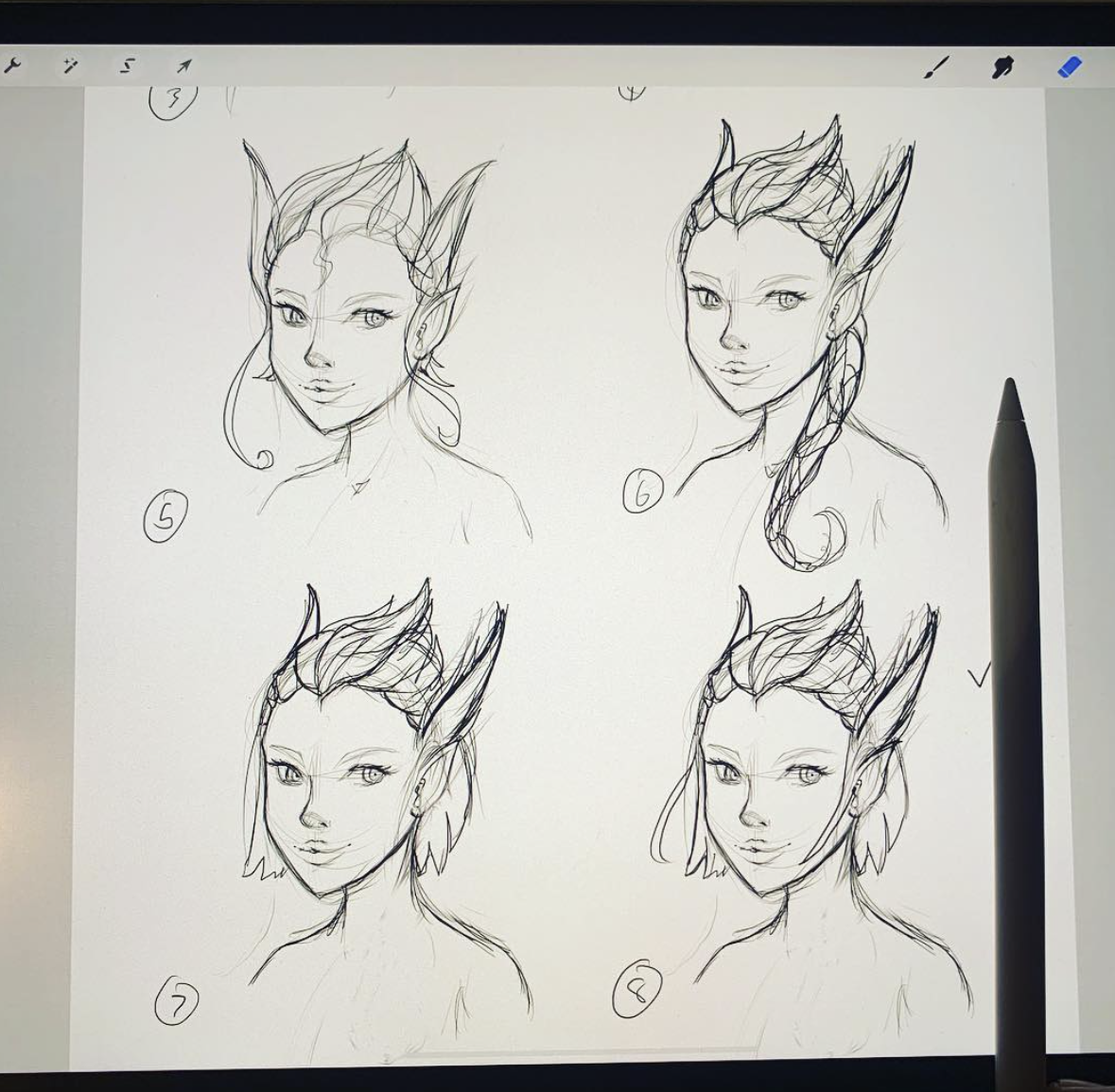
Draw the same neutral face four times and change only the brows. The exercise takes ten minutes and it is genuinely the highest-yield expression practice there is.
Eyes: the lids do the acting
The eyeball is a sphere and it does not change. What changes is how much of it the lids reveal, and what shape they make doing it.
The upper lid is the expressive one. Lowered halfway, it reads as tired, bored or seductive depending on the brow above it. Raised so that white shows above the iris, it reads as shock or mania — that one is powerful and easy to overuse. The lower lid tightening upward is the signature of a genuine smile, and its absence is why a drawn smile can look insincere without anyone being able to say why.
One structural note that fixes a lot of dead-eyed drawings: the upper lid has thickness and casts a shadow onto the eye. Draw the eye as a flat shape with a circle in it and you get a doll. Let the lid overlap the top of the iris and sit slightly in front of the eyeball, and the eye sits inside a head.
Mouths: the corners, not the curve
Beginners draw expression as a curve — up for happy, down for sad. Real mouths express through their corners: pulled back and up, pulled down, pushed forward, tightened, one side only.
Try it on yourself. A smirk is one corner up and back while the rest of the mouth stays level. Disgust is the upper lip pulled up on one side. Contempt is a tightened corner. None of these are curves, and drawing them as curves is why so many expressions read as generic.
The mouth also sits on a curved surface — the front of the jaw and teeth — so it wraps. In three-quarter view the far corner disappears sooner than you expect. Drawing the mouth flat across the face is one of the most common reasons a turned head snaps back to feeling frontal.
Make them agree, or make them disagree on purpose
When brows, eyes and mouth all say the same thing, you get a clear, simple emotion — fine for broad, readable work.
When they disagree, you get a character. Smiling mouth with flat, unsmiling eyes reads as menace or forced politeness. Raised brows with a tight mouth reads as someone trying not to say something. This is where expression stops being a chart and becomes writing.
The practical version: decide the emotion, set all three to match, then deliberately push one against the others and see what the face becomes. That single move is what separates a face that displays an emotion from a face that has an interior life.
The exaggeration question
How far to push depends entirely on style, but the principle does not: exaggerate the relationship, not the feature. Making the eyes bigger does not make an expression stronger. Increasing the distance the brow travels from its neutral position does.
Which is another argument for knowing your neutral. If you have not established where the features sit on a calm face, you have nothing to exaggerate away from. That is why head proportion comes before expression, not after it.
Where this goes next
Facial expression and emotion is Module 7 of Character Art School: Complete Character Drawing, with separate lessons on eyes, eyebrows and mouths and a full demonstration drawing expressions from scratch.
If you work in anime or manga styles, where expression is more codified and pushed considerably further, Manga Art School devotes a module to exactly that vocabulary.